
Church History
Our Church
At the end of the 19th century, Motherwell was growing with the development of local industry. The Church of Scotland saw that there was a need to extend its ministry among the growing population in the Watsonville area of the town. The first meeting place was a converted house in a miners’ row. Under the care of Rev William Smith, the congregation quickly grew and in 1902 moved to a larger building seating 240. This was the Tin Kirk, so called because it was made of corrugated metal.
With further growth in the membership of this young church, it was clear that a larger building was required. A site in Avon Street was found. Both the existing congregation and residents of homes around the new building could easily walk to worship. This fine new church was opened in December 1914. It had taken a year to build at a cost of £4,333. Four years later, St Mary’s became a full Parish Church in its own right.
Although the church itself was large enough to cope with the increasing membership of the congregation, there was a lack of accommodation for mid-week activities, which included Guild, Male Voice Choir, Guides and Boys’ Brigade, so in 1955 a hall was built. Continuing growth in numbers made it necessary to enlarge the premises again and in 1969 a hall, a conference room and a coffee bar were added. A glance at the range of weekly activities will show that the halls are busy all day and all week.
Music is an important part of worship in St Mary’s. In 2007, the pipe organ installed in 1951 was replaced with an Allen digital organ.
It is our purpose that our fellowship should reflect the family nature of God’s people. We are a broad, mainstream congregation of the Church of Scotland, inclusive in our approach and attitude. Our congregational life is based on a commitment to worship, to Christ’s service and to accepting the Lordship of Christ in all aspects of living.
As St Mary’s moves forward from its centenary it is a busy congregation in Hamilton Presbytery, set at the heart of a residential area of Motherwell. We can look back at changes that have taken place. The traditional industries of coal and steel, whose growth was the trigger for the birth of St Mary’s, have largely gone. New housing within the parish has increased the number of homes to 1,700. Within these changes a constant remains: St Mary’s at the heart of the community, Christian worship Sunday by Sunday, Christian life day by day.
The Pulpit Falls
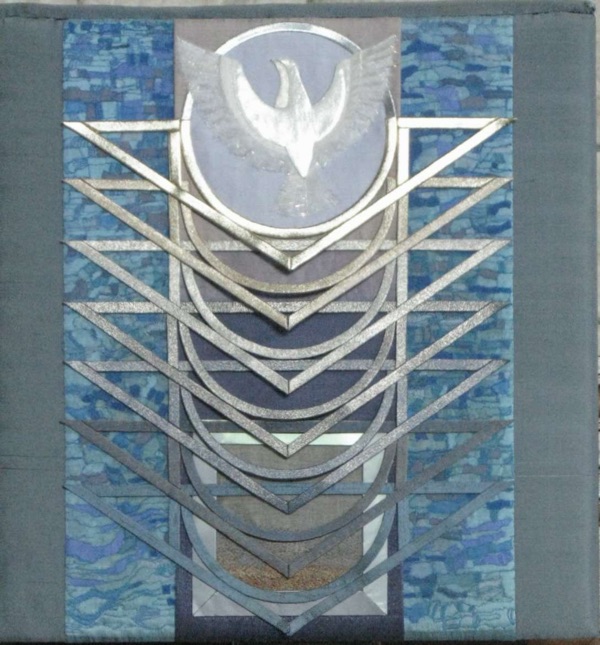
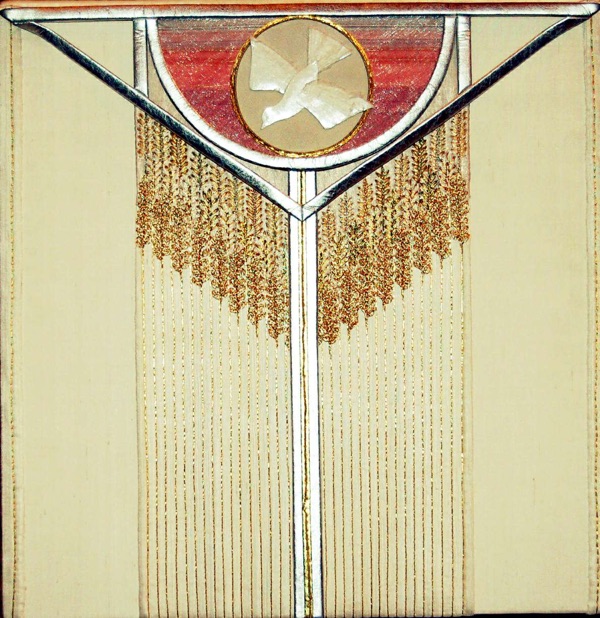
In 1991, two pulpit falls were presented to St Mary’s. They were designed and created by Hannah Frew Paterson, who imaginatively and tastefully wove features of the building and the story of the congregation together in a fine piece of artwork, full of symbolism.
The Blue Fall
Used Sunday by Sunday, the blue fall features the triangular shape of the seven roof beams, represented as metal — a reminder of the church’s industrial origins and of the coal miners and steel workers who formed the congregation until recently. On the blue background are the characteristic microstructures of carbon steel, which reflect the process history of the steel. In the centre is a furnace which, as it were, forged the community in which the fellowship of St Mary’s was born and developed.
The furnace is now damped down, the steel industry having been massively reduced; but rising from it, and ascending through the steel triangles, is a dove — the symbol of hope rising through the supporting beams of our church, into the circle at the top, representing the eternity of God.
The White Fall
The simpler white fall, used on sacramental occasions, employs the same triangular symbol, balanced by a chevron of ears of wheat. In the stem of the wine chalice can be seen the shape of a cross; at the very top appears again the dove, this time descending — the sign of God’s spirit coming upon us.
The Church Organ
Our worship is led by an Allen Renaissance Quantum Digital Computer Organ.
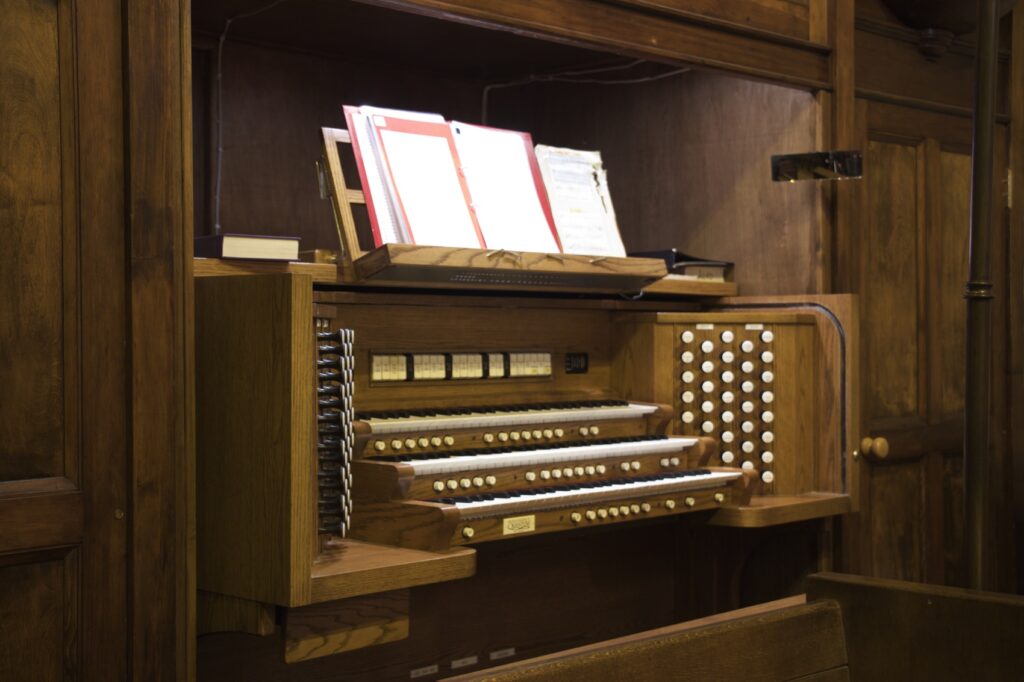
In 2006 it became apparent that the small two-manual pipe organ, which had been installed in the church since 1951, was in need of a major overhaul. Unfortunately the cost of repair was prohibitive, so other options were sought. After exploring many avenues in the organ world, it was decided to replace the pipe organ with a digital organ. Installation of the Allen Organ was completed on 30 August 2007.
The organ features 58 stops and 232 voices of high pipe organ sound quality. There is a complement of thirteen Allen speaker cabinets: 7 in the old pipe organ chamber and 6 placed upon the roof beams above the main body of the church. The speakers on the roof beams are positioned so that the sound reflects off the roof and diffuses into the church below.
The console is a traditional three-manual and pedal console with three 61-note manuals and a 32-note concave and radiating pedal board. The instrument is extremely versatile, suited to Sunday worship, recitals and concerts alike.
In January 2009, international concert organist Carlo Curley gave the inaugural recital, marking a new chapter in the musical life of St Mary’s Parish Church.